5 Finished Songs, One Release Date. Which One Goes First?
November 14, 2026 · 6 min read
Five songs, the same test — a real ranking
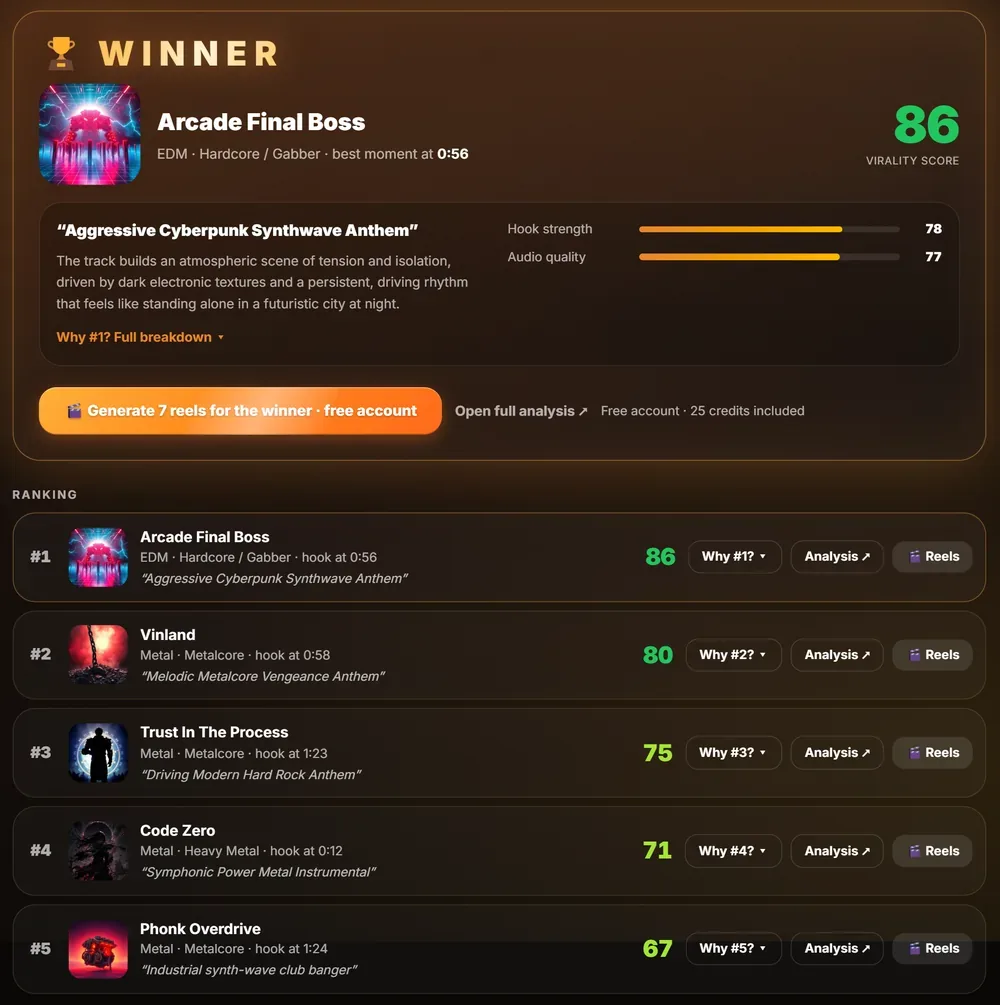
Five tracks by Smoke-Oh, uploaded together on 13 November 2026. The bars look close because scores are close — and the 19 points between first and last are still the whole decision.


The short version
Your favorite song is a guess. So is your newest one. You like the song you worked on longest. Nobody else hears the work.
Give every song the same test. Three things: the hook, the sound, the lyrics. Then put the songs side by side.
The winner goes first. Number two comes next. The winner is your lead single, the runner-up your follow-up. The rest fill the release.
One point apart is a tie. Scores sit close together. When two songs are almost level, pick the one you believe in.
This is what a comparison looks like. Five real songs, uploaded together, ranked a few minutes later — not a mockup:
Compare your own songs now
Drop 2 to 5 songs. Each one gets a score and three bars. You see which one wins.
Free · no account · a few minutes · deleted after 24 hours
Which Song Should You Release First? How to Pick Your Lead Single (5 Songs Compared)
This guide on five real songs: the ranking sorts itself, and you hear the winner's strongest moment next to the last place's.
Click to load the player from YouTube (no-cookie mode). Your IP address is then sent to Google — details in our privacy policy.
Why you can't pick it yourself
You are the worst judge of your own songs. Not because you have bad taste — because you have heard them too often.
You know every song a couple of hundred plays deep. A stranger gives it a few seconds. Those are two different experiences of the same file, and only the second one decides what happens after release.
And the song you call your favorite is usually the one you worked on longest, or the one you finished last. Nobody else hears the work. Nobody else knows which one is new.
The three things to compare in every song
Asking "which song is best?" has no answer. Asking the same three questions of every song does.
Ask: Is there a moment that makes a stranger stop, and how early does it come?
Why it matters: This is the part people meet first, in a clip or in the first seconds of a stream. In the ranking above it is the bar that separates the songs: 78 for the winner, 56 for the last place.
Ask: How clean is the recording and the mix next to other releases?
Why it matters: A weak mix can sink a good song, but it rarely decides between your own songs — they usually come out of the same room. All five songs above sit between 73 and 79.
Ask: Is there a line people can sing back?
Why it matters: Only counts when the song has words. An instrumental is judged on hook and sound alone, so compare it with a vocal track on those two bars, not on the total.
You can run these three checks by ear with people who don't know the songs — play each one and ask at which second they would skip. Or you let the same model rate every song from the audio. On Songbrain the three parts are called hook strength, audio quality and lyrics quality; they count 45%, 35% and 20% of the score, and the same file always gets the same score.
What to do with the ranking
- Number one goes first. It is your lead single — the song that has to work for people who have never heard of you.
- Number two is your follow-up. Release it while the first one is still being discovered.
- The rest fill the release. Strong sound with a weaker hook is an album track, not a bad song.
- Or they go back to the mix. A low bar tells you where. Fix it, then upload the old and the new version together and see whether the change did anything.
Once the order is settled, the next questions are where each song sits on the album and which seconds of the winner you post.
What a ranking can't tell you
It is a judgement, not a measurement of the future. The score rates the song against a fixed rubric. It uses no trend data and is not trained on streaming numbers, so it cannot promise streams. Use it to compare your own songs with each other.
Small gaps mean nothing. Across 659 indie songs measured on Songbrain, the middle song scores 77 and the top 10% starts at 85 — half of all songs sit within a few points of each other. Five points is a real difference. One point is a tie, and then your own conviction is as good a reason as any.
Instrumentals are scored differently. A track without words has no lyrics score and is rated on hook and sound only. Three of the five songs in the example above were rated that way. When you compare an instrumental with a vocal track, compare the hook bar and the sound bar.
FAQ
The one that wins when every song gets the same test, not the one you like best. Compare the hook (is there a moment that makes someone stop, and how early), the sound (how clean are recording and mix) and the lyrics (is there a line to sing back) across all your songs. The winner is your lead single. If two songs are within a point or two, treat it as a tie and pick the one you believe in.
Rank all tracks with the same three checks and take the top one as the lead single and the runner-up as the follow-up. The lead single should be the song with the strongest hook, because it has to work for people who have never heard of you. Songs with strong sound but a weaker hook are album tracks: they reward listeners who are already there.
Because your favorite is usually the song you worked on longest or finished last. You have heard it a couple of hundred times; a stranger gives it a few seconds. Those are different experiences of the same file, and only the second one decides what happens after release.
Yes. On Songbrain you can upload 2 to 5 songs at once, free and without an account. Each song is rated from the audio on hook strength (45% of the score), audio quality (35%) and lyrics quality (20%), and you get a ranking with the winner on top and the three bars next to each song. A comparison takes a few minutes and is deleted after 24 hours.
No. The score is a rating of the song against a fixed rubric — it uses no trend data and is not trained on streaming numbers. It tells you which of your songs has the stronger hook, sound and lyrics, which is a good reason to lead with it. What happens after release also depends on the video, the timing and luck.
Number two is your follow-up single. The rest fill the release as album or EP tracks. A song that loses clearly on one bar tells you what to fix: a low hook bar usually means the strongest moment comes late or does not stand out, a low sound bar means the mix. Fix it, upload both versions together and see whether the new one actually scores higher.
Five songs in. One winner out.
Upload 2 to 5 songs and get them ranked, with the reason next to each one. Free, no account.
Compare My Songs — Free →More guides
Tools for this
Find the Viral Radar for your genre
The best Songbrain songs in your genre, and where your own track would land.