Is Your Suno Song Actually Good? Find Out in 60 Seconds
Upload the export and get a 0–100 Virality Score with its breakdown, the exact seconds your track hits hardest, and 7 reels already cut to them. Free, no card, no account for the first run.
The short version
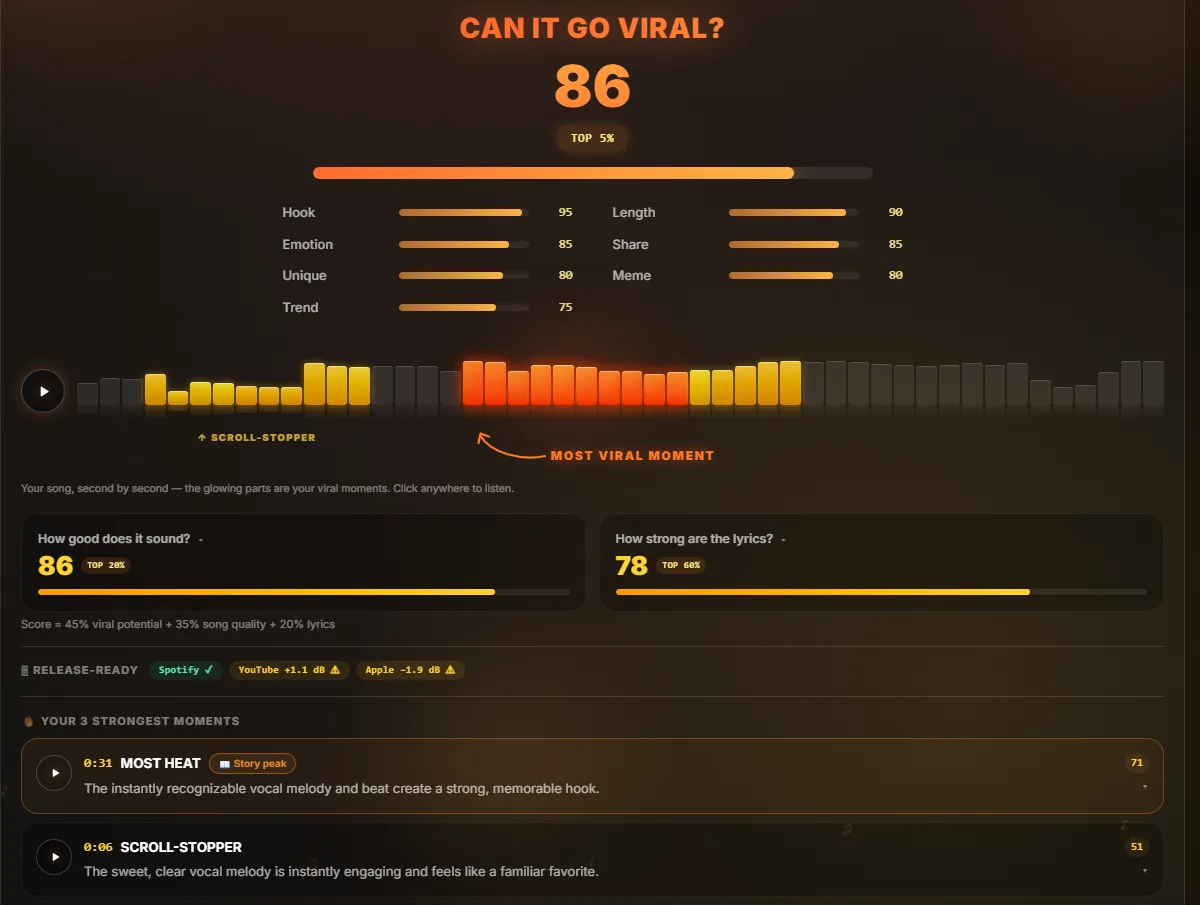
One number, and the reason behind it. A 0–100 score split into hook, emotion, uniqueness, trend, length, shareability and meme potential — so you see what is strong and what is holding the track back.
The second your song hits hardest. Suno tends to bury the chorus around 0:24. The analysis marks the strongest 15 seconds on the waveform and says why they work — that is where your clip starts.
7 reels already cut to it. Storyboard, lyrics, spectrum, VHS and more — vertical, beat-synced, with captions and a 2-week posting plan. The first set is free.
Same scale as human music. Nothing is graded on a curve for AI. You see where the track stands, full stop — which is exactly what you want to know before you release.
This is a real Suno song, not a mockup. “Sugar Rush”, unreleased, uploaded on a free run. Score 86, top 5% — and the strongest moment at 0:31, not where Suno put the chorus.

Score your Suno song now
About a minute for the score, a few more for the reels. Free, no card.
Score My Suno Song — Free →First run without an account · 25 credits when you sign up
Three patterns that sink Suno tracks — and what the analysis shows you
From scoring 200 Suno v4 tracks against 200 human indie releases, these three explain most of the gap. None of them is fatal, and each one is visible in the result.
Suno likes a 2010s arrangement: intro, verse, then the chorus around 0:24. Short-form listeners decide by second 3 and most skip before 12. The analysis shows you the second your track actually hits, so you clip from there — or re-render with the chorus earlier.
Where a human producer stacks three to five layers into the chorus, Suno often adds one. That reads as low contrast in the energy curve — you can see it in the waveform. Fix: a percussion line, a harmony or a counter-melody in the chorus.
Listeners clock an AI vocal before they can say why, and it costs saves. If the lyrics score is strong and the sound score is not, the vocal is usually the reason. The cheapest fix with the biggest lift is a real singer on that one part.
From our public Suno/Udio data study (n=400)
How it works
MP3 or WAV, the full track — 30 seconds minimum. Drop the file in the box above (Suno links don't work, the file does); no metadata, no account for the first run.
About a minute later: the 0–100 score with its breakdown, the waveform with the viral moments lit up, and the reason each moment works.
Seven reels render around the best moment, with captions and a posting plan. If the breakdown says the chorus is buried, re-render in Suno and compare.
Common questions
No — same engine, same scale. The Virality Score is 45% viral potential, 35% song quality and 20% lyrics, and it does not know or care how the audio was made. That is the point: you see where your Suno track stands against everything else.
Yes, that is the most useful way to use it. On the try page you can drop up to 5 versions at once, without an account, and get them ranked. Then compare the breakdowns and keep the one whose hook lands earliest and whose sound score is highest.
Read the breakdown before you release. A low hook score with a high lyrics score usually means the chorus is buried — clip from the strongest moment or re-render with the chorus earlier. A low sound score with strong lyrics points at the vocal.
Not here — nothing on the result depends on it. Your distributor (DistroKid, TuneCore and the rest) is a different story; see the guide on whether Suno songs get demonetized.
The first analysis is free without an account, including the 7 reels in the free set. Create an account to keep the result and you get 25 credits — one more analysis. No card.
The Suno playbook — every guide, by question
Sixteen guides written for Suno artists, grouped by what you are trying to do. Score the track first; then pick the guide for the step you are on.
- How to Make Money With Your Suno SongsThe streaming math, the five routes that pay, the rights you need first.
- How to Get Your Suno Song on SpotifyDistributor, metadata, disclosure — the beginner path.
- Which Distributors Accept Suno SongsEight AI policies checked, September 2026.
- What Is a Music Distributor?Explained simply, for a first release.
- Is Your Suno Song Ready to Release?The 4-check test only 8 % of 316 uploads passed.
- Will Suno Songs Get Demonetized?Spotify, YouTube, TikTok policies and disclosure rules.
- Tidal Stopped Paying AI Songs — What Still WorksWhere the money moved when streaming closed.
- Suno Song to Video (free tool)Your Suno export, cut into 7 reels.
- How to Market a Suno Song11-step playbook: pre-release prep, TikTok seeding, Spotify pitch.
- How to Make Reels for Your Suno SongFree, from the best seconds, no editing.
- A Music Video for Your Suno Song with AIFrom song analysis to a rendered video.
- Best AI Music Video Generators for Suno SongsEight tools compared, which ones block Suno links.
- Suno Capped Your Downloads — What It MeansThe new limits by tier and how to keep your masters.
- 7 Free Downloads a Month — Escape PlanWhat to do with the downloads you still have.
- What the Warner Deal Changed for Suno ArtistsRights, models, what stays yours.
- An AI Country Act Landed 5 Songs on iTunesWhat the chart run tells you about AI releases.
Know before you release
The score, the strongest seconds, and 7 reels cut to them. Free, no card.
Score My Suno Song →